Heidegger's Neglect of the Body by Kevin A. Aho
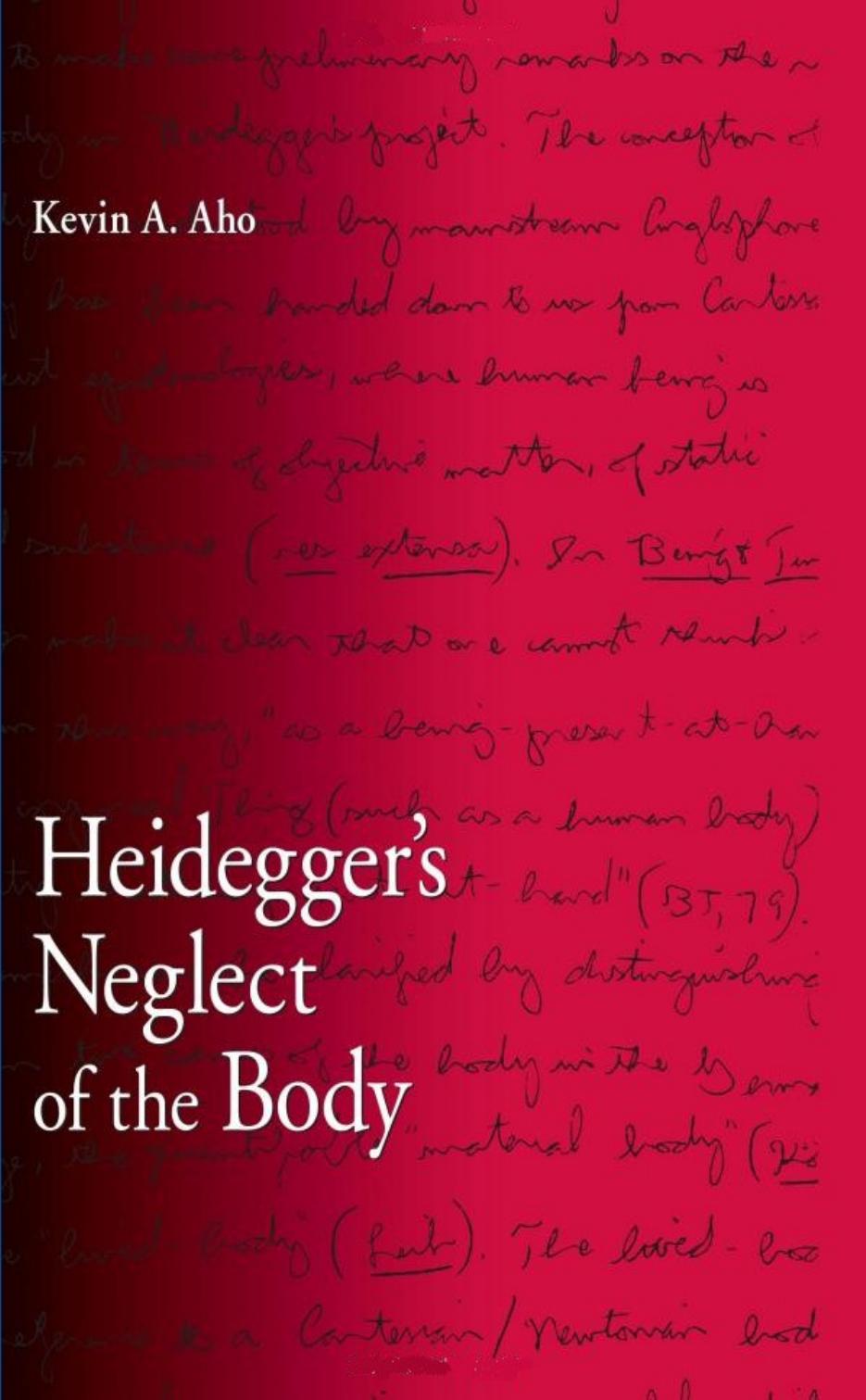
Author:Kevin A. Aho [Aho, Kevin A.]
Language: eng
Format: epub, pdf
Published: 2011-02-17T05:00:00+00:00
Life, Logos, and the Poverty of Animals
95
This uniquely human kind of forgetfulness also results in a uniquely human kind of suffering, “anxiety” ( Angst). As we have already seen, the signifi cance of a mood such as anxiety is not determined by our animal physiology. Humans can be anxious only because they belong to the world in a particular way, a way that makes the physiological experience of anxiety possible. “Only because Dasein is anxious in the very depths of its being,” says Heidegger, “does it become possible for anxiety to be elicited physiologically” (BT, 234).
Anxiety is a mood that discloses my own potentiality for death by revealing the precariousness and instability of the world as the original source of meaning, a source that—in the course of my quotidian affairs—grounds my being, giving purpose and direction to my life.25 Anxiety, in this regard, is not to be confused with fear of this or that thing. One is anxious in the face of no-thing, in the face of the abyssal nature of the world as a whole. The temporal “event” ( Ereignis) that grounds the world, making the disclosiveness of the “there” ( Da) possible, is not anything permanent; it is nothing and nowhere. In anxiety, we experience the nothing as the collapse of meaning, where beings no longer make sense, emerging as meaningless in their bare
“is-ness” (BT, 321). This experience opens up the possibility for a deeper, more authentic understanding of the entire “abyss [ Abgrund]”
of Dasein, the contingency and emptiness that grounds the world and myself (BT, 194). In these moments, I realize that I have no power over this ground, that the meaningful social possibilities opened up by logos are not my own, that I am not the basis for my own being.
Heidegger writes, “ ‘Being-a-basis’ means never to have power over one’s ownmost being from the ground up. This ‘not’ belongs to the existential meaning of ‘thrownness.’ It itself, being a basis, is a nullity of itself” (BT, 330). Anxiety, in this regard, calls me to face the death that “is in each case mine” (BT, 67). Here death is to be understood not as biological “perishing” or “demise” ( Ableben) but as the structure of nothingness that always underlies my time.26
By pulling us out of our tranquilizing routines, anxiety makes it possible for us to soberly acknowledge our own vulnerability, that there is nothing fi xed and constant about existence, that to be Dasein is to be determined by a “not” (BT, 330). Based on Heidegger’s view, because we alone have been appropriated by the abyssal “event” ( Ereignis), we alone can be held out into the nothing, capable of experiencing death as death, as the merciless withdrawal of meaning. Ereignis, in this regard, is the abyssal ground that makes meaning possible, yet it simultaneously threatens to obliterate meaning. “ ‘Ground’ [is] only accessible as meaning,” says Heidegger, “even if that meaning itself is 96
Heidegger’s Neglect of the Body
an abyss of meaninglessness” (BT, 194). Only humans can experience their own death, their own groundlessness, in this way.
Download
Heidegger's Neglect of the Body by Kevin A. Aho.pdf
This site does not store any files on its server. We only index and link to content provided by other sites. Please contact the content providers to delete copyright contents if any and email us, we'll remove relevant links or contents immediately.
| Anthropology | Archaeology |
| Philosophy | Politics & Government |
| Social Sciences | Sociology |
| Women's Studies |
The remains of the day by Kazuo Ishiguro(8999)
Tools of Titans by Timothy Ferriss(8396)
Giovanni's Room by James Baldwin(7346)
The Black Swan by Nassim Nicholas Taleb(7129)
Inner Engineering: A Yogi's Guide to Joy by Sadhguru(6796)
The Way of Zen by Alan W. Watts(6614)
The Power of Now: A Guide to Spiritual Enlightenment by Eckhart Tolle(5782)
Asking the Right Questions: A Guide to Critical Thinking by M. Neil Browne & Stuart M. Keeley(5775)
The Six Wives Of Henry VIII (WOMEN IN HISTORY) by Fraser Antonia(5515)
Astrophysics for People in a Hurry by Neil DeGrasse Tyson(5190)
Housekeeping by Marilynne Robinson(4447)
12 Rules for Life by Jordan B. Peterson(4304)
Ikigai by Héctor García & Francesc Miralles(4274)
Double Down (Diary of a Wimpy Kid Book 11) by Jeff Kinney(4272)
The Ethical Slut by Janet W. Hardy(4253)
Skin in the Game by Nassim Nicholas Taleb(4249)
The Art of Happiness by The Dalai Lama(4130)
Skin in the Game: Hidden Asymmetries in Daily Life by Nassim Nicholas Taleb(4007)
Walking by Henry David Thoreau(3962)
